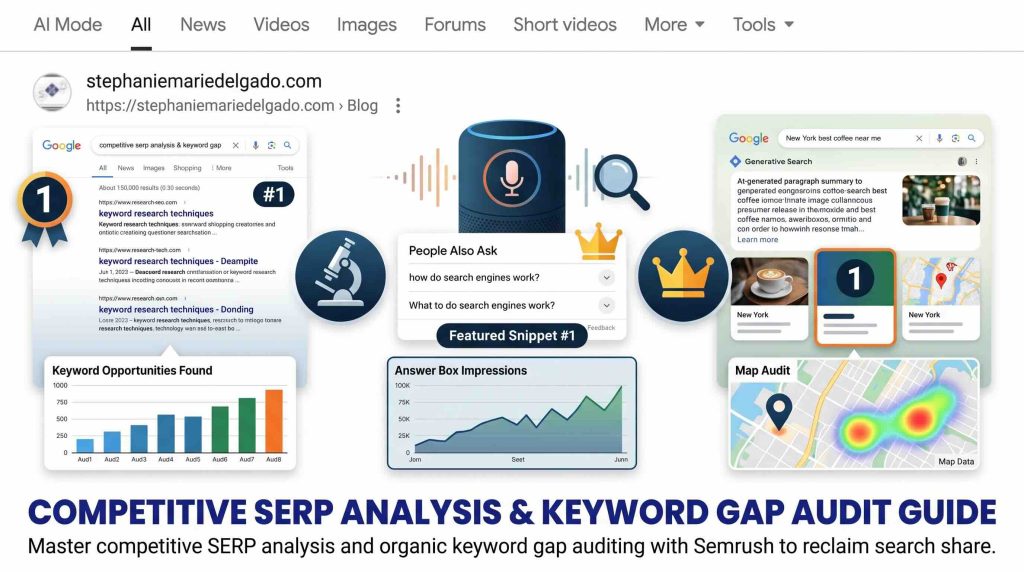
In modern search architectures, maintaining market visibility requires rigorous competitive SERP analysis and proactive keyword gap auditing. As search engine algorithms integrate generative AI overviews and complex crawling mechanisms, technical digital teams must systematically identify untapped search share while resolving deep-seated crawl debt.
1. Strategic Keyword Gap Auditing: Identifying Untapped Real Estate
Keyword gap auditing isolates missing, weak, and unranked search queries by comparing your domain’s indexation directly against top organic rivals.
Executing an effective gap audit ensures your content architecture targets high-converting intent rather than vanity metrics. By systematically evaluating your site’s footprint against market leaders, engineering and SEO teams can prioritize high-ROI content refreshes and net-new landers.
Step-by-Step Keyword Gap Execution Workflow
- Identify Real Competitors: Focus on domain-level organic competitors rather than offline industry rivals.
- Filter for Commercial Intent: Prioritize transactional and commercial queries with high purchase intent over informational broad terms.
- Analyze Missing vs. Weak Positions: Target terms where competitors rank in positions 1–5 while your site ranks outside the top 50 or is unindexed.
- Leverage Advanced Filtering: Use the Semrush Keyword Gap tool to isolate exact keyword overlap and intersect data across up to five rival domains simultaneously.
2. Competitive SERP Benchmarking Framework
Competitive SERP benchmarking evaluates real-time search engine results page features to align content structure with modern search intent.
To capture premium search placement, digital teams must analyze the specific content formats and dynamic features ranking on Page 1. The framework below compares essential SERP features against targeted intent types:
| SERP Feature | Primary Search Intent | Targeted Content Format |
|---|---|---|
| AI Overviews / Direct Answers | Informational / Quick Reference | Structured data tables, concise standard summaries, FAQ schema |
| Featured Snippets | Informational / Comparison | Numbered lists, bulleted key takeaways, direct definitions |
| People Also Ask (PAA) | Exploratory / Consideration | Comprehensive H2/H3 subheadings answering related sub-queries |
| Product Landing Carousel | Transactional | Optimized e-commerce category pages with review markup |
To mine deep long-tail expansions and analyze feature distribution across target clusters, utilize the Semrush Keyword Magic Tool to uncover semantic variations and query volume.
3. Resolving Technical Crawl Debt to Maximize Indexation
Technical crawl debt refers to accumulated site performance bugs, broken redirects, and orphan pages that prevent search engine bots from efficiently indexing content.
Even the best content strategy fails if search engine crawlers exhaust their allocated crawl budget on low-value URLs. Eliminating technical debt requires routine architectural maintenance.
Technical Infrastructure Audit Checklist
- Audit HTTP Response Codes: Resolve 4xx client errors and eliminate 301 redirect chains to preserve link equity.
- Optimize Core Web Vitals: Eliminate render-blocking JavaScript and compress heavy hero media to improve Interaction to Next Paint (INP) and Largest Contentful Paint (LCP).
- Fix Canonical Mismatches: Ensure self-referential canonical tags exist on all primary URLs and parameterized parameters are cleanly scrubbed.
- Verify XML Sitemap Cleanliness: Remove non-200 URLs, redirected paths, and canonicalized pages from sitemaps.
- Automate Technical Scans: Deploy the Semrush Site Audit suite to automatically flag crawl debt, canonical errors, and broken JavaScript components.
4. Capturing AI Search Real Estate & Structured Visibility
Capturing AI search real estate requires structuring site content into machine-readable, concise modules backed by authoritative Schema.org markup.
Search engines increasingly rely on retrieval-augmented generation (RAG) and direct entity extraction. To ensure your platform is cited in AI-generated summaries, adopt structured content blocks, direct header-answer pairings, and microdata markups.
Implementation Steps for AI & SERP Dominance
- Implement Semantic JSON-LD Markup: Embed Organization, Product, Article, and FAQ Page schemas on relevant templates.
- Optimize Headings for Direct Answers: Place single-sentence, highly descriptive answers immediately beneath key H2 and H3 tags.
- Monitor Keyword Volatility: Leverage the comprehensive competitive intelligence inside the Semrush platform to monitor SERP feature shifts, tracking lost and gained positions in real time.